|
Frequently Asked Questions Page Two
READ EVERYTHING THAT
FOLLOWS CAREFULLY AND THOROUGHLY
Although material on this page is
organized topically, don't assume that you can identify what you
should read by picking among the topics. Some material
which is very important to a complete understanding of one
subject area may be found in several different places.
READ THE WHOLE PAGE!
Every individual is responsible for his or her own overall
education, conclusions and decisions, regardless of what may be
read here. Also, those who find their way here but have
not yet read 'Cracking
the Code-The Fascinating Truth About Taxation In America'
might find much of what follows cryptic and/or confusing.
Read the book.
No
other source of information on this subject will suffice-- in
fact, most will simply make the truth difficult to understand.
Indeed, even those who HAVE read the book should be wary in
regard to other sources of information. Many tax
"theorists" and soapbox orators have studied
CtC
themselves and have incorporated elements (or even a great deal)
of what they have learned into their own presentations.
Thus, such presentations may appear on the surface to be soundly
based. However, since these partial-adopters have also
clung to elements (or even a great deal) of their original
misunderstanding, they continue to promote much error-- which is
now just better concealed, or more convincingly presented, than
before.
Click here for more on this.
If needed, click
here for a brief review of the truth about the income tax.
A Lost Horizons "Income" Tax-related Site Map
|
The following links will
take you to the indicated FAQ topic area (but everyone is strongly
encouraged to read this whole page-- material located in one
topic area can often significantly help in understanding the nuances of
a different topic area):
Recent Changes
In The Appearance Of Form 4852
About "Natural" Versus "Artificial" Persons
About "Excess Social
Security and Tier 1 RRTA Tax Withheld"
There
IS "A Law", And This Is How It Works
A Thumbnail
Sketch Of The "Income" Tax Reporting And Determination Process
Does It
Matter If I...
Regarding
Capital Gains, Etc.
Does Filing Initiate
An "Administrative Proceeding"?
What About Getting
Loans?
Is It
Necessary To Make Legal Arguments In A Filing?
Does Submitting A W-4
Make One Into An "Employee" (Or Constitute An Election To Be Treated
As One)?
A "Wage" By Any Other Name Is Still Taxed The Same...
Does Using Federal
Reserve Notes Make An Activity Taxable?
What About Being
Licensed?
Are Activities As
A Public School Teacher Subject To The Tax?
What About Bitcoin?
Frequently
Asked Questions Page One
|
Q. The new Form 4852 is
different from the one in the appendix of CtC. Is
this significant?
Yes, and here's why:
EVEN WHILE MAKING
TENS OF THOUSANDS OF GOVERNMENT ADMISSIONS TO THE CONTRARY
in response to CtC-educated filings over more than ten years
now, and even through repeated form revisions over that
period, the US Treasury Department persisted in accompanying
its "Form 4852 [substitute for incorrect or missing Forms
W-2 or 1099-R]" with language suggesting that the form could
only be used by "taxpayers", and that to use the form, or to
report withheld amounts, was to declare (or agree) that
"taxable income" had been paid. At long last, this
misleading language has been withdrawn and replaced, in a
tacit admission of the truth about both matters.
The faulty and misleading language had never
appeared in the actual declaratory content of the form, of
course. Instead, both false ideas were conveyed by inviting
assumptions from phrasing in the "instructions" published
with the form.
For instance, the "Purpose of Form" instruction
accompanying prior versions declared that, "Form 4852 is
completed by taxpayers or their representatives..." The
casual reader was thereby invited to assume an "only" in
that declaration, even though none actually appears.
Also carefully kept out of the form's
declaratory content, and thus never crossing the line into
directly implying that adverse inferences attend the use of
the form as a legal matter while still being predictably
misleading, language in the "Line-by-line" portion of the
previous versions' instructions read, "Line 4.
Enter the year the taxpayer had taxable income from which
Federal taxes were withheld..."
In addition to appearing merely in the
instructions and plainly reflecting self-serving assumptions
about who would be using 4852s (in harmony with the
revenue-hungry state's default position that any given
economic activity is of the taxable variety unless and until
declared otherwise by the actor), neither of these
misleading expressions were definitive or pre-emptive. As
noted above, there was no "only" in this language.
But at the same time, the retention of this
misleading wording even after a growing number of Americans
began using 4852s to rebut allegations of the receipt of
"income", and despite several revisions of the form--
including revisions of the instructions-- each plainly in
direct response to this new application of the form, was
unquestionably a deliberate effort to corruptly encourage
uncertainties and anxieties about this use of the form.
Happily, some honest individual or group at the Treasury
Department couldn't stomach the deception any longer, and a
few months ago, the 4852 was revised yet again, this time
with the misleading language removed.
(It's possible that honesty had nothing to do
with this new, improved revision... Perhaps the change
occurred due to virtuous push-back by CtC warriors.
No one has ever faced an assertion that 4852s
couldn't properly be used as the CtC-educated use them. But
some have had occasion to debunk a ridiculous assertion that
amounts can only be withheld from "income" payments, and
that therefore declaring that amounts have been withheld is
to declare that "income" has been paid, made by an IRS or
DOJ hack floundering about for an adverse argument in a
legal contest. See some discussion of this subject
here.
This latter "argument" is so patently
untenable and embarrassing even just to read or hear-- and
so readily debunked by simply inserting a big red
"properly" into it, as, "amounts can only
properly
be withheld from "income" payments..."-- that someone in a
position of authority may well have commanded that it be abandoned.
After all, to trot out such a desperate argument, or even just to allow it to be
suggested by the 4852 instruction language, is to more
overtly admit to having no argument against a CtC-educated
claimant than to simply say nothing...)
SO, LET'S LOOK AT HOW THE 4852 WAS BEFORE CtC
and how it was changed in several revisions intended to
discourage the educated CtC community (even while its
members' claims continued to be routinely honored). Then
we'll look at what it has now become in a tacit admission of
the CtC-revealed truths the state still finds hugely
inconvenient to its unbridled ambitions but no longer dares
to deny in this fashion.
At the time of CtC's publication in 2003
the 1998 version of the form was the current version.
Page 1 of that form-- the only page at which anyone HAD to
look, since it's the one with all the "action" elements--
presented nothing at all capable of affecting one's view of
the form's utility. Here is the bottom portion of that page,
where we find the only text on the page which is not part of
one of the fields to be completed:

On page 2 of the form we find the old portions
of text which are the subject of our discussion, and which
were, pre-CtC, not unreasonable in their inclusion. After
all, pre-CtC, it is likely that the form would never have
been used other than by someone who believed both
expressions to be apt and unremarkable:

At the end of 2005,
after the IRS had begun to be inundated with CtC-educated
filings as word of the liberating truth about the tax
spread, Form 4852
was revised. The "Paperwork Reduction Act" notice was
shouldered off page 1 by the misleading "Purpose of Form"
language (and some additional
somewhat-discouraging-appearing material brand new for this
revision). This change was plainly intended to deceive and
discourage the growing army of newly awakened and upright
ex-coppertops:

At the same, time, a slight change was made in
the "Line 4" instruction which remained on page 2 ("the
taxpayer" is replaced by "you"):

By early 2007,
CtC-educated claimants were recovering all their money
in ever-greater numbers. This was both for the simple reason
that the liberating truth about the tax continued to rapidly
spread, and because in April of 2006, the government had
launched
a new, transparently corrupt effort to discourage that
spread which predictably backfired due to its
particulars constituting unmistakable evidence of both the
accuracy of
CtC's information and the importance of that information
being acted upon by every grown-up American with a smidgen
of common-sense and love of country.
Still in its reflexive stonewall mode, the
government rolled out another revision of Form 4852,
retaining the misleading "Purpose of form" language on page
1 and adding penalty warnings which had never appeared
anywhere on the form or its instructions in the past:

Page 2 of the form was essentially unchanged
other than as necessary to account for the fact that some
line numbers on the form had been changed. The misleading
"line 4" language remained the same.
The return of improperly-withheld and -paid-in
amounts by the federal and, by then, 33 state tax agencies
and treasury departments ratcheted up during the subsequent
several years. Within a year of this 2007 revision just the
tiny fraction of these refunds
generously furnished to me for posting and sharing with the
world had reached a pace averaging $83,000.00 per month.
However, rather than just face the facts like a man and
reconcile itself to
the unchallengeable legal reality it was quietly acknowledging with every refund check, the
government doubled-down, as is its reflex. In late 2008, after
years of internal proposals to try to charge me with
something in order to frighten people away from CtC--
each of which was declined by the IRS's own "criminal
division"-- and despite its failure to secure a real
grand jury indictment, the DOJ "tax division" in
Washington produced an unsigned "indictment" charging me
with not really believing that my earnings don't qualify as
"wages" (under a special tax-law "perjury" provision).
A suitably manipulated show-trial followed a year later,
resulting in a foreordained conviction.
As with the similarly-bogus, similarly
truth-emphasizing "civil lawsuit" attack, this criminal
assault just galvanized truth-fueled, truth-spreading
American men and women. Even after I checked in at a federal
prison, refunds based on what I was charged with not
believing to be true continued to be demanded, and continued
to issue forth, week after week.
Again desperate to frighten the people away
from the inescapable, but oh, so inconvenient truth, the
feds cranked out yet
another revision of Form 4852 in late
2010. (It's worth noting at this point that prior to 1998,
Form 4852 had not had a single revision of any of the
varieties discussed here in all its prior 24 year history. A
number of forms had been issued during those years--see
here,
here,
here,
here,
here and
here-- but the changes in all these cases simply
involved some tweaking of the formatting, responses to the
OMB-numbering requirements introduced in the 1980s, and the
addition of pension-return applications.)
The 2010 revision again retained on page 1 the
misleading, misstated "Purpose of form" language and kept
the beginning of the threatening "penalty" section
front-and-center. New was a chunk of actual gibberish,
apparently added by a bureaucracy in such a lather to order
the tide to recede that either no time was spent
proof-reading the work or the level of desperation had
reached the point at which resort was being made to sheer
confusion. Look at the second highlighted paragraph (below
the "Purpose of form" language, which remained as it had
been in prior versions):
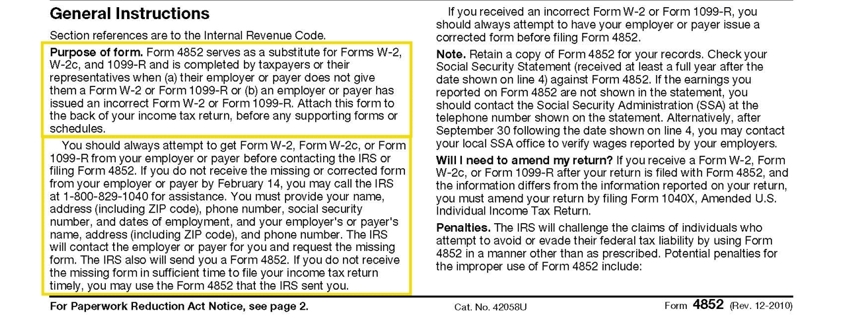
Enjoy this. ON THE FORM 4852 IN YOUR HAND you
are advised to contact the IRS so that... it can send you a
Form 4852...? Somehow, I suspect that if a CtC-educated
person were to climb through this looking-glass and get an
IRS agent on the phone what he or she would receive would be
nothing helpful. But I'm a cynic by nature (well, by
experience, really).
Anyway, this gibberish was the sole addition
and apparent reason for the 2010 revision. The material on
page 2, the "Line 4: Enter the year you received taxable
income from which federal income taxes were withheld"
included, remained virtually identical to the corresponding
instructions on the page 2 accompanying the 2007 form:

SO, QUITE A LITTLE CAMPAIGN TO DISCOURAGE,
INTIMIDATE AND CONFUSE educated Americans from successfully
making their inconvenient rebuttals and reclamations over
the first ten years since
CtC first revealed the liberating truth in 2003!
FINALLY, though, someone has found
him-or-herself obliged to excise the overt,
egregiously-misleading "Purpose of form" and "Line 4"
language previously clung-to on these forms over all those
years and through all those revisions.
Finally, the effort to falsely imply that
the Form 4852 is only for use by "taxpayers" (and to falsely
imply that use of the form supports a presumption of
self-endorsed "taxpayer" status) has been abandoned.
Finally, the effort to falsely imply that
"withholding" can, as if by a law of nature, only
be applied to "taxable income" (and to falsely imply that
reporting amounts withheld implies an agreement that what
they were withheld from was "taxable income", whether the
"wages" variety or any other) has been abandoned.
That long-standing misleading language has
FINALLY been replaced with new expressions acknowledging
that NON-"taxpayers" also can and do use these forms, and
that reporting amounts withheld says nothing whatever about
the propriety of that withholding, or the legal character of
what it was withheld from.
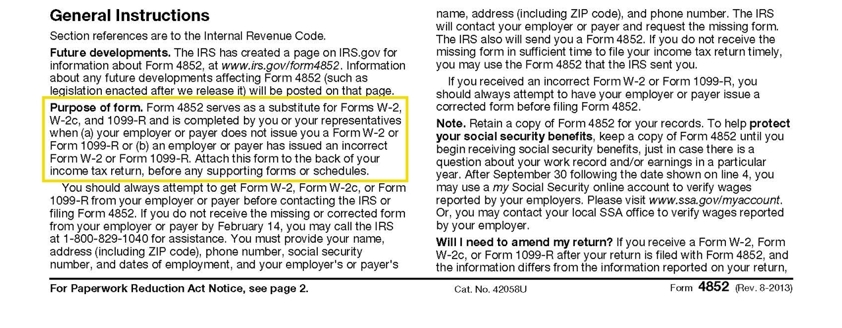
In August of 2013-- exactly ten years after the
publication of
CtC, the Department of the Treasury
replaced previous versions of Form 4852 with its
new, much-improved model, acknowledging every
CtC--thing about these forms. Here is page 1, with the
new, straightforward "Purpose of form" language:
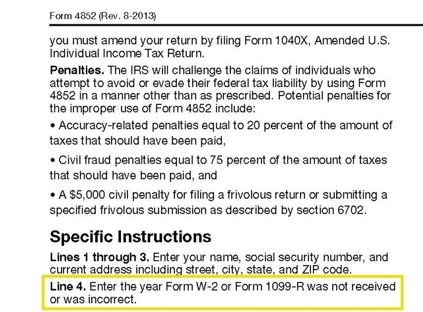
Here is page 2 of the new form, with the new,
no-longer-flogging-the idiotic-withholding-argument "Line 4"
language:
It's about time. P.S. In 2014, the
signature line was removed from the form. Not a
significant change, in my view, as a form attached to a
1040 is covered by the 1040 attestation anyway.
BUT WAIT, THE EFFORTS TO DISCOURAGE,
INTIMIDATE AND CONFUSE educated Americans have
resumed in 2020! Now we see another change in the form,
and one plainly meant to be misunderstood.
The new form begins with a statement appearing to
require a user of a Form 4852 to confront a payer and
demand a W2c or corrected 1099:

Anyone not tuned-up in agency tactics would almost
certainly be misled into thinking that unless they make
that confrontation, possibly endangering their
relationship with the payer, they must abandon plans to
use the form to rebut an incorrect W-2 or 1099-R. Such a
misled person might very well be discouraged and
dissuaded from reclaiming their property.
The educated filer, of course, will recognize the need
to look further. Doing so will be fruitful.
AT THE BOTTOM of page 1 of the form the general
instructions will be found, and here we find the
reference to an "Attempt to get..." put quite a bit
differently:

Suddenly, "must" becomes "should", and the incongruous
proposition that you can only rebut an errant payer's
assertions if you have tried to convince him to change
his statements is revealed as a deception (or, at least,
is flatly contradicted). Continuing on to
page 2 of the form, we see the "deception" conclusion
ratified yet again. Here, the instruction for "Line 10"
on the form asks for an explanation of "any attempts" to
get the payer to change his tune, rather than "YOUR
attempts", as it would say if you really were required
to make such attempts:

How tiresome these people can be! |
|
Q. You say in your
foreword (7th edition and earlier):
"Corporate
managers, though, are warned that this book does not
directly address the peculiarities of the "income" tax
as it applies to artificial persons." Does
this mean that "income" means something different for
artificial persons than what it means for "natural
persons"?
A. Not at all. "Artificial persons" are
relevantly viewed by the law in precisely the same
fashion as "natural persons", and both are taxed on the
same activities, and nothing but the same activities.
"Income" means the same thing for both; and the gains of
artificial persons are not "income" simply because the
one enjoying the gain is an artificial person, even in
the case of a federally-created artificial person
(although it is almost certainly the case that
pretty-much every gain enjoyed by most federally-created
or controlled artificial persons will be from the
conduct of a taxable activity).
The "disclaimer" language you cite simply reflects the
fact that I devote very little of CtC to discussing how
state-chartered corporations (or LLCs, etc.) are made to
appear to be federal or federally-controlled
corporations ("domestic corporations", or "corporations
organized under the laws of the United States", etc.).
(See
this for
additional material on this topic.)
|
|
Q. Is the "Excess Social
Security and Tier 1 RRTA Tax Withheld" line on a
1040 the proper place for reporting or reclaiming
what is withheld from non-"wage" earnings under the
names "Social Security and/or Medicare taxes" (and
should "Form 843" be used for this purpose)?
A. No. The following explanation of what
that line IS for (and what "Form 843" is for, as
well) is taken from the IRS online "Tax Topics"
collection, topic #608:
Most employers must
withhold social security tax from your wages.
Certain government employers (some federal,
state, and local governments) do not have to
withhold social security tax.
If you work for a railroad
employer, your employer must withhold Tier 1
railroad retirement (RRTA) tax and Tier 2 RRTA
tax.
If you had more than one
employer and your total wages were over the wage
base limit for the year, too much social
security tax or Tier 1 RRTA may have been
withheld. The wage base limit for the year can
be found in the Form 1040 Instructions. If you
had more than one railroad employer, and your
total compensation was over the maximum amount
of wages subject to Tier 2 RRTA, too much Tier 2
railroad retirement (RRTA) tax may have been
withheld. If you had too much social security
tax or Tier 1 RRTA withheld, you may be able to
claim the excess as a credit against your income
tax. If any one employer withheld too much
social security or RRTA tax, you cannot claim
the excess as a credit against your income tax.
Your employer should make an adjustment of the
excess for you. If the employer does not make an
adjustment, you can use Form 843 (PDF), Claim
for Refund and Request for Abatement to claim a
refund.
If you are claiming excess
social security or Tier 1 RRTA tax withholding,
from having 2 or more employers, you cannot file
1040EZ. You must file Form 1040 (PDF) or Form
1040A (PDF). To claim a refund of the Tier 2
RRTA tax, use Form 843 (PDF). If you are filing
a joint return, you cannot add any social
security or RRTA tax withheld from your spouse's
income to the amount withheld from your income.
You must figure the credit separately for both
you and your spouse to determine if either of
you had excess withholding.
For details, including how
to compute the amount of excess credit, refer to
Publication 505, Tax Withholding and Estimated
Tax.
To clarify: The "Excess Social Security and Tier 1
RRTA Tax Withheld" line on a 1040-- and "Form 843"--
are only for the use of those who DID receive "wages",
but had the FICA or Tier 1 RRTA sur-tax applied to
more of those "wages" than it should have been.
The sur-tax only applies to "wages" up to a certain
amount (currently $94,200). Those who had the
sur-tax applied to "wage" receipts above that amount
can use the "Excess Social Security and Tier 1 RRTA
Tax Withheld" line to claim a refund of that excess
amount withheld.
Those who have received no "wages"
CANNOT have "Excess Social Security Tax Withheld".
They can only have "Improper Social Security Tax
Withheld", and the proper way to reclaim it is by
combining it with normal federal income tax withheld
for one big figure on the appropriate line of a
1040.
See this for more.
|
A Thumbnail
Sketch Of The "Income" Tax Reporting And
Determination Process
A helpful summary of certain core "income" tax
dynamics
At the close of the reporting period (December 31st,
in most cases), payers considering themselves
obliged to issue taxable activity reports create and
execute one or more of the various "information
return" reports (W-2s, 1099s and K-1s, mostly),
sending one copy to federal, state and/or local tax
agencies, and one copy to the person about whom the
document makes its allegations.
Having thus been put on notice that allegations of
having received "income" have been reported to the
government(s) to whom any resulting tax would be
owed, the reportee either:
A. Lets the allegations go without response--
thus inviting the tax agency (we'll just focus
on the federal system, now) to:
-
presume them correct and true;
-
create a "SFR" "module" in order to
calculate the resulting tax liability
(without going into the legitimacy of doing
so in any particular case-- if no response
has been made to "income" allegations, a
door has been left pretty wide open for all
manner of presumptions about the legal
status of the reportee); and to
-
claim ownership of any withheld or
paid in amounts up to that calculated
liability, and/or (eventually) issue an
appropriate "Notice of Deficiency" for any
outstanding balance.
(NOTE: The agency is also thus invited to impose
available statutory sanctions, such as a
"failure to file" penalty, for instance.
This is because the requirement to file-- which
generally arises upon receipt of a threshold
amount of "income"-- and jurisdiction for the
imposition of sanctions have been presumptively
established by the allegations of the taxable
activity report and the failure of the reportee
to rebut them after being put on notice.)
or
B. Responds to the allegations by filing a valid
(that is, accurate, honest, and self-consistent)
return which either:
1. Acknowledges the reported taxable
activity ("income"), claims appropriate
deductions, credits, exemptions etc.,
calculates the resulting tax liability and
self-assesses,
or
2. Corrects or rebuts the reported "income"
amount(s), claims appropriate deductions,
credits, exemptions etc. (if applicable and
relevant), calculates the resulting tax
liability and self-assesses (very possibly
resulting in an assessed liability of $0.00
and a claim for the return of everything
withheld or paid-in).
(NOTE: Returns rebutting allegations of the
receipt of "wages" and/or "trade or
business"-generated "income" simultaneously
rebut jurisdictional presumptions which could
otherwise be supported by those allegations.)
In the case of B(1) or B(2), the IRS can then:
a. Issue a refund check or credit (if
the self-assessed amount is less than
the amount withheld, paid in, carried
forward, or otherwise available for
crediting for that period-- thus
resulting in an "overpayment");
b. Bill the filer for any balance due if
the amount assessed on the return is
more than the amount withheld, paid in,
carried forward, or otherwise available
for crediting for that period;
or
c. Make a determination that the amount
self-assessed is deficient and issue a
"Notice of Deficiency"-- but only on the
basis of the rate of tax having been
incorrectly applied to the amount of
"income" shown on the return (through
math and/or deduction/exemption/credit
reduction errors).
It will be noted that each of these latter IRS
response options are confined to calculations based
on the amount of "income" reported on the return.
When a return has indeed been filed, the agency has
no authority to do otherwise. This is why when
it wishes to thwart an educated American (which is
to say, when it wishes to evade the tax laws and the
required issuance of properly-claimed refunds), the
IRS will try to deny the relevant return was ever
filed.
Toward that end, the agency has actually gone so far
as to deny ever having received the returns of some
educated filers whose returns made claims the agency
did not wish to honor-- an, "Our junk-yard dog
must've eaten your tax return!" routine.
This only delays the inevitable for a brief time, of
course, while the filer walks a copy in to the local
office and personally oversees having it stamped as
received, or otherwise secures incontrovertible
evidence of the agency receiving the filing.
Thus, alternative ploys are becoming more common
when the IRS wishes to evade the law. One is a
simple declaration that the return is "frivolous"
(under the statutory definition at 26 USC 6702-- a
status which, when accurate, means the return can be
treated as though never filed, according to current
doctrine), in the hope that the filer will back down
in confusion and fear. (Click
here for more about this revealing ploy, which
would obviously never be attempted if the law
provided for any other means of defeating a claim,
and
here for a series of case-studies of CtC
Warriors who have dealt with this, and other
tax-agency ploys.) Then the agency will follow
up with with the steps outlined earlier in section
"A."
Another is to invite the filer to abandon his
testimony, by proposing alternative numbers on a
convenient form which the filer can sign under
penalty of perjury and thus adopt as a modification
of his previously-filed return-- as though what had
been filed must simply have been a big mistake, from
which the filer will surely back down (in confusion
and fear).
CtC-educated Americans do not back down in
confusion and fear, of course...
|
|
Q.
Does it matter if
multiple returns are sent to a tax agency at the same
time (or in the same envelope), as opposed to one at a
time (either by mailing date or packaging)?
A. It is hard to imagine why any such detail would
make a bit of difference, absent some published request
by the agency that things be done in a particular way
for bureaucratic processing purposes (personally, I've
never seen an official request in this regard, although
I've also never looked...). Best way to find out,
if this is really a concern, is to call the relevant
agency and ask, I would think.
That said, I understand that this question reflects the notion that one should strive to
avoid "standing out", presumably based on the view that
tax agencies are unscrupulous and will target for
harassment and resistance even perfectly proper filings
and claims that come to their attention. But this notion
itself reflects a misunderstanding of just
what exercising one's right to introduce one's testimony
into the record (or simply claim a return of one's
property)-- and, more broadly, standing up for the rule
of law-- is all about. Subterfuge, or the wish to be
"off the radar screen", has no place in the upholding of
the law. Tricks and shadows are for those doing
wrong, not for those doing right. (See
this for some
related material.)
|
|
Q. I've read through your book
and searched the website for information on how to
possibly report capital gains and dividends from
non-national banks. My first thought is capital gains
are only paid by taxpayers not non-taxpayers but I
really don't know.
A. In order to qualify as "income", any gain,
however labeled, must be of the same general legal
character as anything else that so qualifies. That
is, in order to qualify as "income" any gain must be a
consequence of the (profitable) benefit
of the exercise of
a federal privilege, power or
property (which may, of course, be an "exercise by
proxy" in the form of an investment in an entity which
is doing the "exercising" directly).
By the same token, allegations (or actual
receipt) of "capital gains" can and should be addressed
in exactly the same way as any other allegation (or
actual receipt) of "income", however labeled. Generally,
the appropriate model will be how one would handle what
would be reported or alleged by way of a "1099-MISC".
BTW, get clear on this important cognitive
nugget: anyone can potentially be a
"taxpayer". It is not the character of the actor
that makes gains taxable (even though because of their
nature some actor's gains will always be of a taxable
character), it is the character of the gains that makes
an actor into a "taxpayer" (insofar as-- and only
insofar as-- those particular gains are concerned).
|
|
Q. Am I stuck in an "administrative
proceeding" with the tax agency once I file a return?
A. Quite the contrary. Filing an accurate,
proper return on which less than the exemption amount of
"income" is declared establishes that one IS NOT in an
administrative proceeding with the relevant tax agency.
This is why tax agencies try so hard to induce everyone
to let the agency disregard the filed return, using any
means necessary from elaborate efforts to suggest the
returns are somehow defective (and that the agency is
authorized to make such determinations unilaterally!) to
the frankly comical claim that, "The return must have
gotten lost in the mail, Mr. Smith!" (See the 'Every
Which Way But Loose' collection for more on this.)
On the other hand, those who declare having received
more than the exemption amount of "income" on a return--
or don't file, and allow "information return"
allegations of having received more than the exemption
amount of "income" to prevail by default-- ARE stuck in
such a proceeding. These unfortunates have become
"taxpayers" subject to such proceedings due to (and to
the extent of) those declarations or unanswered
allegations.
|
|
Q. What about getting loans?
Lenders usually ask to see tax returns. Won't
accurate tax returns which show no (or little) "income"
make it impossible to get a loan?
A. Actually, lenders and others who provide
earnings-related financial services don't have any
interest in how much "income" anyone does or doesn't
make, generally (although there may be some federal
financial service entities specifically providing
"income"-related services that would be exceptions to
this, I suppose). Financial services folks are
really only interested in how much money one makes,
because that's what matters where one's ability to repay
a loan, or one's qualification for aid, or whatever, is
concerned.
A number of CtC Warriors have had this issue arise.
They have found that the folks with whom they are
dealing are perfectly happy to accept alternatives to
tax returns for documentation of earnings, such as pay
stubs, affidavits, bank statements and so forth.
In the face of truly mindless resistance to
alternatives one might consider submitting complete tax
returns, but particularly including rebuttal instruments
such as forms 4852 and rebuttals to 1099s, K-1s and so
forth which would help make clear that the 1040 form is
not a declaration of having not received money, but only
of having not received "income". W-2s could also be
presented, with a notation to the effect that while the
inherent characterization of the payments reported on
the forms as being from taxable activities is disputed
and rebutted, the forms serve as evidence of the payee's
receipt of money in the amounts shown.
|
|
Q. Is there any need or
virtue to including legal arguments in a filing
supporting or justifying what is being reported?
A. In a word, no. Once a testimonial
declaration as to the factual matters with which the
filing is concerned is made (by way of the return) and
appropriate testimonial declarations in rebuttal of any
allegations that amounts were received during the
relevant period as a consequence of engaging in a
taxable activity (by way of affidavits in response to
"information returns", such as Forms 4852, or corrective
responses to 1099s, etc.), the tax agencies are required
as a matter of law to accept that testimony as
definitive and final.
Further, even if the
agencies were NOT required to accept the filer's
testimony, a tax agency/government that wishes to assert
a competing claim to what has been established by the
filer's declarations would bear every burden of proving
its claim.
Unless someone has already conceded the point in his or
her filed return, or given it up by default through
non-filing, the burden of proving that IT has a claim to
withheld money is ALWAYS on the government in any
dispute situation. The return will have formally
asserted the filer's continuing ownership and right to
possess that property:
“Even if you do not otherwise have to file a
return, you should file one to get a refund of any
Federal income tax withheld.”
From the instructions for the 2002 Form 1040
***
26 CFR 301.6402-3
Special Rules applicable to income tax
(a) In the case of
a claim for credit or refund filed after June 30,
1976--
(1) In general, in the case of an overpayment of
income taxes, a claim for credit or refund of such
overpayment shall be made on the appropriate income
tax return.
...
(5) A properly executed individual, fiduciary, or
corporation original income tax return or an amended
return (on 1040X or 1120X if applicable) shall
constitute a claim for refund or credit within the
meaning of section 6402 and section 6511 for the
amount of the overpayment disclosed by such return
(or amended return).
***
Senator Clark: "Of course, you withhold not
only from taxpayers but nontaxpayers."
Mr. Hardy: "Yes."
...
Senator Danaher: "I have only one other thought
on that point. In the event of withholding from the
owner of stock and no taxes due ultimately, where
does he get his refund?" Mr. Friedman:
"You're thinking of a corporation
or an individual?"
Senator Danaher: "I am talking about an
individual."
Mr. Friedman: "An individual will file an income
tax return, and that income tax return will
constitute an automatic claim for refund."
Excerpted from a Withholding Tax hearing
on August 21 and 22, 1942 before a subcommittee of the
Committee on Finance, United States Senate, during the
77th Congress, Second Session, on data relative to
withholding provisions of the 1942 Revenue Act. Missouri
Democratic Senator Bennett Clark, Connecticut Republican
Senator John A. Danaher and testifying witnesses Charles
O. Hardy of the Brookings Institution and Milton
Friedman of the Treasury Department Division of Tax
Research.
The filer does not have to prove his ownership and right
to that property-- it never stops belonging to him
unless and until a competing claim could be, and is,
proven both: 1.) to be possible (that is, until it is
proven that he actually engaged in a relevant taxable
activity) and 2.) to have been asserted in a legally
meaningful way (that is, until it is proven that a valid
assertion of the government's contrary alleged claim can be, and
has been, made in a legally meaningful way). See
this for more on "asserted in a legally meaningful
way".
Further, this same dynamic applies anytime a tax agency
suggests that it gets to assume ownership of anyone's
property (either by taking that property or by keeping
it) in the face of a proper assertion of ownership and
claim for refund by the annual filer. "We
changed your account [to our benefit]...", for
instance, doesn't mean anything unless preceded by,
"We proved that you did something making you beholden to
us for $x.xx, that we have the authority to assert our
claim despite your relevant filed return(s) and self
assessment(s), and that we did, in fact assert that
claim in a legally meaningful manner." Otherwise, it's really just, "We're implying that we
have some god-like authority to assume ownership of
whatever we wish, and we hope you've been sufficiently
brow-beaten and confused by the life-long conditioning
to which we have subjected you to imagine that this
could be true..."
(NOTE: See 'About 1040s And Claiming Refunds' in
CtC for more on this subject.)
|
|
Q. Does filling out a W-4 make one
into an "employee", and one's pay into "wages", or
amount to a voluntary election to be treated as an
"employee" (and having one's pay treated as "wages")?
A. The completion and submission of a W-4 doesn't
make someone not engaging in taxable activities into
someone who is (nor does it constitute an election to be
so treated as though one were engaged in such
activities). After all, filling out a W-4 doesn't
constitute the completion of a federally-connected civil
service application or an oath of office, or becoming an
officer of a federal or federally-controlled
corporation...
Thus, for one who is not actually an "employee" the
completion of the form must be presumed to be entirely
prospective in nature, providing in advance for the
theoretical possibility (however remote) that one's
relationship with the company to which one presents the
form might somehow become that of "employer" and
"employee" at some unknown point in the future (while
otherwise being legally irrelevant). Whether or
not such a theoretically-possible change actually takes
place at any point is reflected in the content of one's
filing concerning each past year.
That said, the submission of a W-4 without a qualifying
declaration COULD serve to support inaccurate
presumptions about the nature of one's activities.
See 'W-4s- The Blind Leading The Blind...' in CtC and
what you find here for
more on this.
|
|
Q.
Does using Federal Reserve Notes (FRNs) make an activity
taxable?
A. In a word, no.
CREATING FRNs might be the exercise of a federal
privilege or power, but using them certainly is not, any
more than using the interstate highway system or getting
scanned by the TSA at an airport are taxable activities,
or make anything you do on your trip a "taxable
activity". No such things are specified as taxable in
any law. Nor could they be, as each would make the
income tax an improper capitation in that any of these
(and especially the "using FRNs" one) would effectively
lay the tax on all economic activity.
Further, "gain" is an integral requirement of "taxable"
and there is no "gain" from the use of FRNs because of
some speial characteristic of the notes, whether
accepting them or paying with them (other than as their
creator). If anything, someone being paid FRNs is
thereby inherently losing value, due to the inflation to
which the notes are inherently vulnerable.
On the other hand, being paid with FRNs IS a measure of
economic activity in the normal sense of the term and is
a receipt of value, however much one might feel their
issuance to be Constitutionally invalid. Whatever else
may be said about FRNs, they ARE claims against the
assets of their issuer, as is plainly declared in 12 USC
§ 411:
"Federal reserve notes, to be issued at the
discretion of the Board of Governors of the Federal
Reserve System for the purpose of making advances to
Federal reserve banks through the Federal reserve
agents as hereinafter set forth and for no other
purpose, are authorized. The said notes shall be
obligations of the United States and shall be
receivable by all national and member banks and
Federal reserve banks and for all taxes, customs,
and other public dues. They shall be redeemed in
lawful money on demand at the Treasury Department of
the United States, in the city of Washington,
District of Columbia, or at any Federal Reserve
bank."
Clearly, receiving FRNs is no different from receiving
any other medium of exchange in any sense relevant to
the tax.
Further still, the law specifically says that what
someone engaging in taxable activity gets paid in
doesn't matter. It isn't the being paid, or what one is
being paid with that matters, it's what one did
for which one is being paid
that matters.
See 'A "Wage" By Any Other Name Is Taxed The Same' in 'Was
Grandpa Really a Moron?' for more about this; also
see the definition of "gross income" as interpreted by
the Treasury Department at 26 CFR § 1.61-1(a)
"(a) General definition. Gross income means all
income from whatever source derived, unless excluded
by law. Gross income includes income
realized in any form, whether in money, property, or
services. Income may be realized, therefore, in the
form of services, meals, accommodations, stock, or
other property, as well as in cash."
(emphasis added);
and the definition of
"wages" at 3401(a):
"(a) Wages
For purposes of this chapter, the term “wages” means
all remuneration (other than fees paid to a public
official) for services performed by an employee for
his employer, including the cash value of all
remuneration (including benefits) paid in
any medium other than cash..." (emphasis
added).
When one combines this with the fact that
other portions of law specifically provide that some
payments to "employees" for services performed for an
"employer" DON'T qualify as 'wages" and are NOT subject
to the tax, and do so without a qualifying specification
negating these exceptions of taxable status if payment
is made in FRNs, it is clear that not only does no
provision of law support the proposition that use of
FRNs is taxable, but the structure of the law positively
contradicts this notion.
|
|
Q. Is it a privileged, taxable
activity to act economically as a "licensed this or
that"?
A. A license is permission to engage
in the licensed activities for, or with, the licensor.
That is, if one acquires a license from a state to
perform some activity (such as a plumber's license) the
only privilege that can be being conveyed by the license
is that of performing the activity for the state. After
all, it's obvious that anyone has a right to sell
plumbing services to anyone else generally, and doing so
isn't exercising any privilege.
Consequently, activity performed for the licensing
entity is potentially taxable by that entity as the
exercise of privilege (though it may or may not actually
be taxed-- for instance, it may be that the only actual
tax applied in connection with licenses issued by one of
the several states may be the fees associated with
getting and maintaining the license). At the same time,
the same activity performed by the same person elsewhere
would remain just an activity of common right, not
subject to that privilege tax as such. Even performing
the activity for someone who insisted on the performer
having such a license in order to be hired would not
make that performance into the conduct of a privilege
granted by the licensing entity.
Sensibly or not, such insistence is common, because
licenses have historically been seen as implying
superior skill or as evidence that the licensee has met
some tested level of quality. Those able to do so have
always advertised their positions as "dressmaker to the
Queen" or "licensed to argue cases before the King's
bar", figuring it gave them a leg-up on the competition
in marketing themselves to others. The notion, I
imagine, is the sub-textual suggestion that "the King"
or "the Queen" can afford, or will always insist upon,
the best, so someone to whom they've granted license to
do business with the apparatus of the state must really
be good. Those seeking services often buy into these
notions, and insist that their service-providers be able
to exhibit licenses. But the fact that someone is
"licensed" to do privileged work doesn't make work one
has every common right to do into something taxable by
the licensor.
By the way, a significant legal doctrine rears its head
in connection with licensure. As observed by a court in
an 1869 ruling concerning a challenge in part to the
Constitutionality of the power of the government under
section 49 of the revenue act of 1868 to "examine all
persons, books, papers, accounts and premises", and to
compel persons to appear, and to produce books and
records, in order to ascertain the correctness of a
return (In re Meador, 16 F. Cas. 1294 (ND Ga.
1869)):
And here a thought suggests itself. As the
Meadors, subsequently to the passage of this
act of July 20, 1868, applied for and
obtained from the government a license or
permit to deal in manufactured tobacco,
snuff and cigars, I am inclined to be of the
opinion that they are, by this their own
voluntary act, precluded from assailing the
constitutionality of this law, or otherwise
controverting it. For the granting of a
license or permit-- the yielding of a
particular privilege-- and its acceptance by
the Meadors, was a contract, in which it was
implied that the provisions of the statute
which governed, or in any way affected their
business, and all other statutes previously
passed, which were in pari materia
with those provisions, should be recognized
and obeyed by them. When the Meadors sought
and accepted the privilege, the law was
before them. And can they now impugn its
constitutionality or refuse to obey its
provisions and stipulations, and so exempt
themselves from the consequences of their
own acts?
Of course, even under this doctrine the
government actions to which the licensee could be said
to have agreed by implicit contract must be confined to
those concerning the exercise of the privilege granted,
not any and all activity of the licensee period. That
is, the government can (under this doctrine) freely
examine the books of the licensee in which his sales,
etc., under the permissions of the license are made
(which is to say, those to the licensing entity), but
not his sales to the
general public for which no license is needed (even
though what is being sold is exactly the same as what he
is licensed to sell to the government).
In fact, in the later case of
Stanwood v.
Green, 1870 U.S. Dist. Lexis 279 (1870) which
dealt with the same subject, the court explicitly
draws the distinction between the two classes of
otherwise identical activities, acknowledging that a
target of an examination summons need only produce
that portion of his business records concerned with
his taxable activities (see the discussion of
this ruling in the "NOTES" section of
this page). But no one should be surprised if a
pretext will be seen by virtue of a license under
which the government claims the need and right to
examine ALL business activities concerning the
object of the license anyway, in order to ensure
that the taxable portion of these activities are
accurately reported...
|
|
Q. Are activities as a public school
teacher subject to the tax?
A. If a public school teacher's activities are as a
federal school teacher, such as those discussed
here, they would be potentially subject to the
"income tax" (I say "potentially" because not all
"income" is actually always subjected to the tax, even
though it qualifies). The personal services of public
school teachers rendered in the capacity of "an officer
or employee of a State, or any political subdivision
thereof, or any agency or instrumentality of the
foregoing," are also included-- where "State" is defined
as in the discussion of the Public Salary Tax Act of
1939 on pp. 70-72 of CtC. By the same token, this would
exclude public school teachers who are NOT of these
varieties (which is to say, any working for a
union-state school-district).
The parameters are not expanded or affected by federal
grants or other federal foot-prints littering the halls
of public schools not meeting the criteria outlined
above. Just as the benefit of federal privilege
exercised by an otherwise private business makes the
business's profits potentially taxable, but not the
earnings of the workforce-- even though possibly being
paid straight out of money secured from the feds, the
institutions (such as the school districts or schools
themselves) which receive education-related grants and
other benefits might themselves be subject to
obligations and liabilities thereby (and not only
tax-related obligations and liabilities), but this
doesn't reach further to penalize or encumber the
work-force. THEIR relations are just with the
institution, not the institution with which their
institution has relations.
|
|
Q. What About Bitcoin?
A. THERE HAS BEEN A FLURRY OF WORRY and
fuss over recent IRS efforts to secure information
on bitcoin transactors. The anxiety is misplaced.
Let me say first that there is nothing
inherently taxable about using or receiving bitcoin.
It's just a medium of exchange like any other. There
is no tax on exchanges per se, nor on profits, gains
or receipts, per se.
By the same token, however, there is
a tax-- measurable by the value of bitcoin
received-- for doing taxable things resulting in
those receipts. That is, not all things done for
which bitcoin might be received are taxable, but the
receipt of bitcoin is relevant to the tax when
received for doing taxable things.
THE BOTTOM LINE IS that concern about
IRS prying into records of bitcoin transactions is
misdirected. The concern should be at the prying
itself, without regard to the bitcoin element.
Unless it has been previously
established that a taxable activity has been
conducted, the IRS has no valid interest in any
transaction. Thus, a blanket demand for information
on all transactions is an offensive, possibly 4th
amendment-violating intrusion.
AT THE SAME TIME, anyone and everyone
engaging in bitcoin transactions and troubled by
these bureaucratic intrusions MUST BECOME
CtC-EDUCATED. That and that alone will protect
from all the practical ill-effects of such
intrusions (which routinely happen in other venues,
such as conventional banking, anyway).
Only those ignorant of the hidden
truths about the income tax have reason to fear
information falling into the hands of the IRS. So,
keep on keeping crypto. Just
get educated about the tax, too.
|
Frequently Asked Questions Page 1
|